
Authors: Dinys Luciano and Jenedith Montenegro
The Amazon rainforest, spanning territories in Brazil, Bolivia, Peru, Ecuador, Colombia, Venezuela, Guyana, Suriname, and French Guiana, is increasingly vulnerable to climate-related emergencies, including droughts, floods, and wildfires. These environmental events not only threaten the ecological balance but also generate significant psychosocial risks for the populations residing within and around the forest.
Linkages between climate change and mental health
The cumulative effects of climate change are increasingly pronounced and enduring, with both direct and indirect impacts on mental health and psychosocial well-being (World Health Organization, 2022).[1]
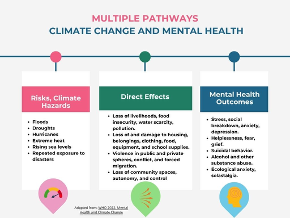
Environmental degradation, socioeconomic stressors, and cultural upheavals intersect to shape mental health outcomes in the Amazon. Prolonged exposure to extreme weather events correlates with heightened incidences of post-traumatic stress disorder, depression, and anxiety. These impacts are especially acute among indigenous and marginalized communities, who require targeted, culturally responsive mental health interventions.
Indigenous populations, particularly young people, are experiencing escalating mental health challenges due to the erosion of traditional livelihoods and rapid environmental degradation. Cultural dislocation, exacerbated by the encroachment of external economic systems and extractive industries, intensifies experiences of distress and hopelessness. [2] For example, in Brazil’s Acre state, increasing cycles of drought and flooding have been empirically linked to rising rates of depression and social instability (Silva et al., 2023).[3] Similarly, the states of Pará and Mato Grosso have endured severe environmental degradation from wildfires, resulting in forced displacement and disruption of indigenous cultural and spiritual practices (Sinimbú, 2025). [4]
The 2023–2024 South American drought had a profound impact on communities in Brazil, Bolivia, Peru, and Colombia, resulting in severe water shortages, food insecurity, and population displacement. In northern Peru, environmental contamination from extractive industries has compounded psychological distress within the Awajún communities. The transition from subsistence to market-based economies has further exacerbated water insecurity and its associated psychosocial consequences (Tomassi, 2019).[5]
Gender differences in mental health conditions
Analysis of depression, anxiety, and suicide rates across the nine Amazonian countries reveals critical gender-based differences in mental health. According to data from the Pan American Health Organization (PAHO), women consistently show higher rates of depression and anxiety. In comparison, men exhibit significantly higher suicide rates—a pattern particularly pronounced in Guyana and Suriname.
Understanding these sex-disaggregated patterns is essential for designing effective mental health responses to climate-related psychosocial consequences. Climate change acts as a multiplier of mental health vulnerabilities through its disruption of livelihoods, social roles, and cultural identities. These impacts are experienced differently by women and men, making gender-sensitive approaches vital for equitable and effective psychosocial support.
Table: Depression, anxiety, and suicide rates by sex in Amazon region countries (per 100,000 pop)
| Country | Depression (W/M) | Anxiety (W/M) | Suicide Rate (W/M) |
| Brazil | 7.5 / 3.9 | 7.7 / 3.6 | 3.1 / 9.3 |
| Bolivia | 5.8 / 3.0 | 8.1 / 4.9 | 3.4 / 11.0 |
| Peru | 5.9 / 3.1 | 8.4 / 5.2 | 1.8 / 5.8 |
| Ecuador | 5.7 / 2.9 | 7.8 / 4.6 | 1.9 / 6.3 |
| Colombia | 6.2 / 3.2 | 8.5 / 5.3 | 2.6 / 8.4 |
| Venezuela | 5.6 / 2.8 | 7.6 / 4.4 | 1.2 / 4.0 |
| Guyana | 6.4 / 3.4 | 8.7 / 5.5 | 18.6 / 63.0 |
| Suriname | 6.1 / 3.1 | 8.3 / 5.1 | 12.3 / 39.5 |
| French Guiana | 6.0 / 3.0 | 8.0 / 5.0 | 3.9 / 12.5 |
Source: PLISA, PAHO[6] *W= women, M= men
These findings underscore the need for differentiated mental health strategies. While women are more frequently affected by mood and anxiety disorders, men face a substantially higher risk of suicide. In countries like Guyana and Suriname, the scale of gender differences in suicide demands urgent, targeted mental health interventions.
Strategies for effective risk mitigation
To address the growing psychosocial toll of climate-related emergencies, governments in the Amazon region should prioritize culturally competent and community-centered mental health strategies.
Key actions include:
- Community-based mental health services: Expand mental health services that are locally grounded and culturally appropriate, particularly in remote and indigenous territories. These services should promote resilience and provide continuous care throughout the climate emergency cycle.
- Training in Psychological First Aid (PFA): Equip first responders, community leaders, and local health professionals with skills in Psychological First Aid to ensure rapid, empathetic support during and after crises.
- Public awareness and education campaigns: Develop educational campaigns to raise awareness about the mental health effects of climate change, reduce stigma, and promote help-seeking behaviors. Tailor content for diverse population groups, including children, adolescents, women, men, indigenous peoples, and Afro descendants.
- Integration into Disaster Risk Reduction (DRR) plans: Embed psychosocial components into national and subnational DRR frameworks. This includes provisions for cultural continuity and the strengthening of community resilience as part of emergency preparedness and response.
- Protection of vulnerable groups: Design and implement mental health interventions that prioritize groups disproportionately affected by climate stressors, such as women, children, indigenous communities, and persons with disabilities.
Conclusion. The deepening climate crisis in the Amazon is not only an environmental emergency but also a psychosocial one. Its mental health consequences are particularly acute for communities already facing poverty, exclusion, and cultural erosion. A coordinated, multisectoral response that integrates mental health into environmental, public health, and disaster governance systems is essential to safeguarding long-term well-being and resilience in the region.
How to cite: Luciano, D., & Montenegro, J. (2025). The Climate Within: Psychosocial Impacts of Environmental Change in the Amazon and How to Respond. Integrativa Online DVCN. For more information: Dinys Luciano (lucianod@integrativa-online.com) and Jenedith Montenegro (jenedithm.integrativa@gmail.com) https://integrativa-online.com
[1] World Health Organization (2022). Mental health and Climate Change: Policy Brief. Geneva. https://iris.who.int/bitstream/handle/10665/354104/9789240045125-eng.pdf?sequence=1
[2] Neuronline. (2023). Neuroscience and Mental Health in the Amazon. https://neuronline.sfn.org/scientific-research/neuroscience-and-mental-health-in-the-amazon
[3] Silva, S., Brown, F., Sampaio, A., Silva, A., Santos, N., Lima, A., Aquino, A., Silva, P., Moreira, J., Oliveira, I., Costa, A., & Fearnside, P. (2023). Amazon climate extremes: Increasing droughts and floods in Brazil’s state of Acre. Perspectives in Ecology and Conservation, 21. https://doi.org/10.1016/j.pecon.2023.10.006
[4] Fabíola Sinimbú. Brasil registra aumento del 79% en áreas quemadas durante 2024. AGÊNCIA BRASIL. 26/01/2025
[5] Tomassi, L. (2019). Water insecurity and mental health in the Amazon: Economic and environmental impacts on the Awajún communities. Economic Anthropology, 6(2), 304–316. https://doi.org/10.1002/sea2.12144
[6] PLISA, PAHO. Core Indicators Portal. https://opendata.paho.org/es