
Lessons from the NIMOBI Pilot
Dinys Luciano, Kreena Govender, Wendy Alba and Jenedith Montenegro
Integrativa Online DVCN, BOLD Global Alliance, COSALUME and FUNDEPRE
Programmes for adolescents often focus on strengthening their knowledge, skills and emotional well-being. However, one question accompanied the design of Girls in Motion and Well-Being (NIMOBI) from its earliest stages: What happens when adolescent girls return home after each session?
Changes initiated during a programme are more likely to be sustained when girls return to a family environment that listens to them, supports them and reinforces what they have learned. For this reason, in addition to the sessions for adolescent girls, NIMOBI incorporated a component for mothers, fathers and guardians based on short messages sent through WhatsApp. As the first weeks of the pilot progressed, this component began to teach us something more.
What Does the Evidence Say?
Research consistently points to three findings:
- Family support continues to be one of the main protective factors during adolescence (National Academies of Sciences, Engineering, and Medicine, 2019; Kapetanovic & Skoog, 2021).
- Programmes that involve families generally achieve better outcomes than those directed solely at adolescents (Catalano et al., 2012; Viner et al., 2012).
- Complex interventions are not always necessary. Everyday actions such as listening attentively, recognising strengths and talking about emotions can make a significant contribution to adolescent well-being (National Academies of Sciences, Engineering, and Medicine, 2019).
Although this component is aimed at mothers, fathers and other caregivers, most of those participating in the pilot are women. Various studies show that mothers’ emotional well-being and the quality of the relationships they establish with their children have an important influence on mental health and positive development during adolescence (Jones et al., 2023; Choi et al., 2025).
The NIMOBI Approach
NIMOBI’s approach is simple. While adolescent girls participate in in-person sessions focused on physical activity, emotional well-being and life skills, their families receive short messages that address the same topics within the home. At the same time, community organisations and local institutions support the process. In this way, adolescent well-being no longer depends solely on the sessions but also begins to be built through the everyday relationships surrounding adolescent girls. NIMOBI was designed using a multilevel perspective inspired by the socioecological model of human development. This model recognises that people’s well-being is determined not only by their individual
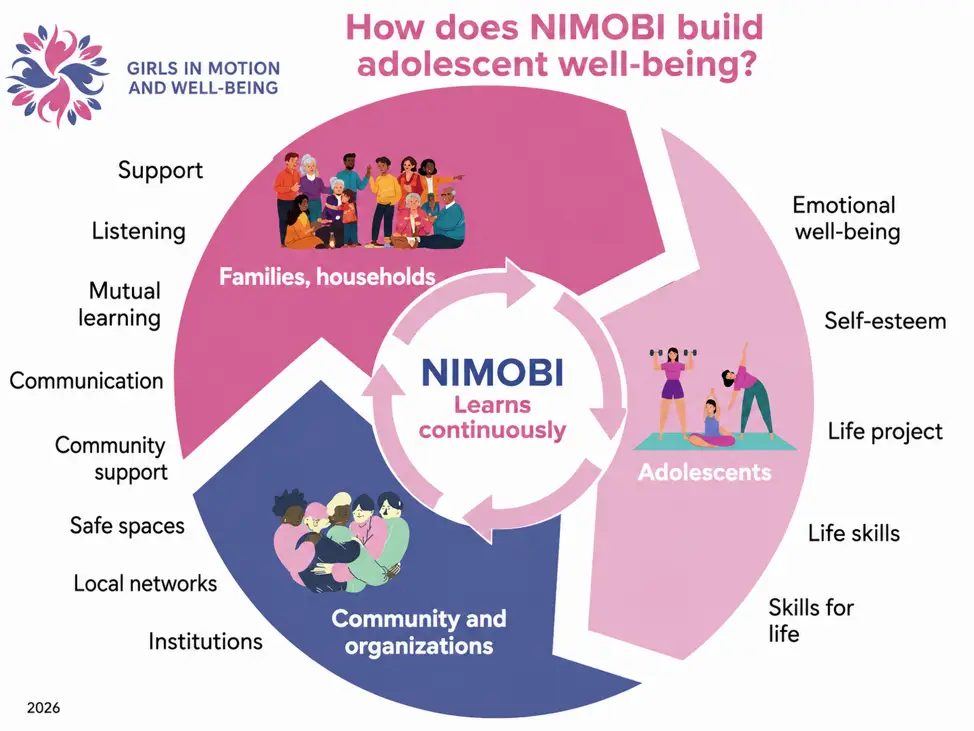
characteristics, but also by family relationships, community environments and the broader social contexts in which they live (Chaplin et al., 2025; Golden & Earp, 2012).
More Than Sending Messages
During the pilot, mothers, fathers and guardians receive two messages each week, coordinated with the topics being addressed with the adolescent girls. Each message contains three simple elements:
- an evidence-based idea;
- a reflection for the family and the people who share the household; and
- a practical action to carry out during the week.
The purpose is not to increase the responsibilities placed on families, but to offer simple tools that can easily be integrated into everyday life.
An Unexpected Lesson
When the pilot began, we believed that this component had a very clear purpose: to strengthen family support for adolescent girls. However, the first few weeks led us to an additional reflection.
Many mothers, fathers and guardians dedicate much of their time to caring for others but have few spaces in which they themselves can feel supported or share their own experiences. Gradually, we came to understand that this component could also become a space for support and mutual learning—a space where families not only receive tools, but where NIMOBI also learns from them.
Their experiences, questions and suggestions help us to better understand the everyday realities of those who support adolescent girls and enable us to continuously strengthen the programme. Caring for those who provide care is also part of adolescent well-being.
Learning Together with Families
One of the objectives of the pilot is to continue improving this component. That is why we want to listen to families. At the end of the programme, we will ask them a few simple questions:
- Which messages did they find most useful?
- Which topics generated the most discussion at home?
- What did they learn during the process?
- What could we do better?
Their responses will be just as important as the results obtained with the adolescent girls, because they will enable future versions of NIMOBI to be developed based on the experiences of those who live the programme every day.
Looking Ahead
One of the main lessons from this pilot has been the understanding that adolescent girls’ mental health and well-being is not built solely through activities directed at them. It is also strengthened when households and families have the tools to support them, and when families’ own experiences are heard and valued.
NIMOBI will continue to evolve together with adolescent girls, families and communities, because we believe that social programmes must also continue to learn.
References
Catalano, R. F., Fagan, A. A., Gavin, L. E., Greenberg, M. T., Irwin, C. E., Ross, D. A., & Shek, D. T. L. (2012). Worldwide application of prevention science in adolescent health. The Lancet, 379(9826), 1653–1664. https://doi.org/10.1016/S0140-6736(12)60238-4
Chaplin A, McGuinness L, Gadermann A, Poon BT, Jenkins EK. Contributors to positive mental health among youth: a qualitative study in British Columbia, Canada. Health Promot Int. 2025 Jul 1;40(4):daaf127. doi: 10.1093/heapro/daaf127. PMID: 40726153; PMCID: PMC12304415.
Choi H, Lee J, Kim E, Youm Y, Sung K, Han DG, Park MH. Effects of Loneliness and Subjective Well-Being on Depression in Female Adolescents: A Longitudinal Moderated Mediation Model of the Parental Relationship. Psychiatry Investig. 2026 Jan;23(1):142-153. doi: 10.30773/pi.2025.0297. Epub 2025 Dec 26. PMID: 41437548; PMCID: PMC12835636.
Golden, S. D., & Earp, J. A. L. (2012). Social ecological approaches to individuals and their contexts: Twenty years of health education and behavior health promotion interventions. Health Education & Behavior, 39(3), 364–372. https://doi.org/10.1177/1090198111418634
Jones B, Durtschi J, Keilholtz B. Maternal engagement, relational closeness, and adolescent internalizing symptoms: The association of engaged mothering with adolescent depression and anxiety. J Marital Fam Ther. 2023 Oct;49(4):861-878. doi: 10.1111/jmft.12662. Epub 2023 Aug 15. PMID: 37582343.
Kapetanovic S, Skoog T. The Role of the Family’s Emotional Climate in the Links between Parent-Adolescent Communication and Adolescent Psychosocial Functioning. Res Child Adolesc Psychopathol. 2021 Feb;49(2):141-154. doi: 10.1007/s10802-020-00705-9. Epub 2020 Sep 22. PMID: 32960375; PMCID: PMC7826314.
National Academies of Sciences, Engineering, and Medicine. (2019). The promise of adolescence: Realizing opportunity for all youth. National Academies Press. https://doi.org/10.17226/25388
Viner, R. M., Ozer, E. M., Denny, S., Marmot, M., Resnick, M., Fatusi, A., & Currie, C. (2012). Adolescence and the social determinants of health. The Lancet, 379(9826), 1641–1652. https://doi.org/10.1016/S0140-6736(12)60149-4
How to cite: Luciano, D., Govender, K., Alba, W., Montenegro, J. (2026, July). When Families Are Also Part of Adolescent Well-Being: Lessons from the NIMOBI Pilot. Perspectivas Integrativas. Integrativa online DVCN. https://integrativa-online.com/blog/