
Integrativa online DCVN colleague and somatic experiencing practitioner
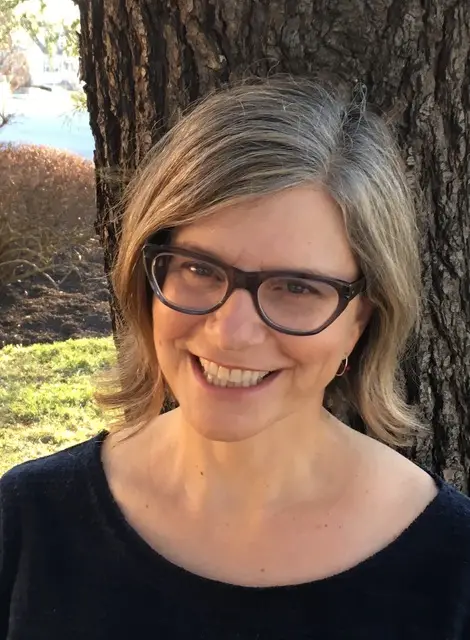
Anne K. Eckman, PhD, LCSW-C, SEP
talks about how greater attention to our embodied experiences can support well-being in our day-to-day lives. Below are highlights of Anne’s conversation with a friend from the Caribbean
This is part of an occasional interview series on mental health and well-being, hosted by Integrativa online DVCN. Each conversation explores a key issue and offers practical tips that can help sustain our readers who are often on the frontlines of providing community care.
When we think of our mental health and well-being, how does bringing more attention to our bodies fit in?
Anne: Well, a couple of things are at the top of my mind: Bringing more attention to the body and our experiences of living embodied can offer a really important resource for our overall wellbeing. And yet there are lots of reasons why many of us aren’t that connected to our bodies…
Part of it is we’ve had lots of experiences often where our bodies are not especially safe. We also have had lots of experiences where I may have been taught or learned to override what our bodies need to be able to be present for other people or to do things we’re expected to do in our lives. And then I think in many western approaches to mental health, there’s also a forgetting that we live embodied lives.
A friend from the Caribbean: I totally agree with what you said. Also, at least in my country, listening to your body and trying to identify what your body’s telling you is not part of the culture. We have trouble connecting with our bodies and understanding what they’re telling us, and maybe thinking: Why do I have this symptom? Or why does my stomach want to explode when I am angry or sad, or when I have anxiety about something?
I think at least in some families, not just countries, reading your body is not part of what you do on a daily basis.
Anne:Exactly. So as a somatic experiencing practitioner, I work with people to figure out what it means to be more aware of our embodied experience – how this can help us to better understand what we are experiencing, have more options to respond to what’s happening, and ultimately expand our capacity to feel more alive and well in ourselves.
What does it mean to “bring more awareness” to our body?
Friend: For me, it’s funny because some people are like: What is taking care of your body? It’s going to the gym. For me, that has never been something. But I like walking. It makes me feel better. It clears my head and everything.
There are so many stereotypes about what you need to do to recover some sense of balance. But it’s actually so different from one person to another, what feels good in our bodies.
Anne: I agree. I think what we’re talking about is for each of us:What does it mean to notice what might bring us a bit better sense of feeling well within our own body?
Friend: For me, one example is taking a nap. I have recovered that for several years now, and it is magical. 15 minutes, 20 minutes. Sometimes it’s not even nap, it’s just lying down on the couch with no one talking to me. And I feel like another person.
Anne: Wow. I love that.
Friend: That’s also happened to me with cooking. Cooking is an intensive labor thing. But for whatever reason, it feels different for me. I cook most of the days. I do it quickly, but I enjoy that. I don’t like washing dishes and all that stuff, but I do like the act of cooking. And being able to eat it…. At the end, I reward myself with a taste. Then I say, “This is so good.”
Anne: So you get to enjoy that.
Friend: Yes. That’s why I think there are so many ways to find peace. Not peace, but some things that can balance your day. You can find ways to integrate into your daily life.
Anne: I know for me those daily things have shifted over time. Right now, I have a list of favorite dance music that I can put on for 5 minutes and move my body. I know parents who try to have mini dance moment with their kids – as a mini break for themselves and also for their kids. As you said, the key is finding what’s accessible for you.
So how can we start to notice more fully what is happening in our bodies?
Anne:This is such an important question.
From the perspective of somatic experiencing, we do this slowly and in small steps, because it can bring up a lot to notice our bodies more. So we typically invite people to notice: After this activity that helped bring a sense of balance or pleasure, what is one small thing that’s a little different in your body or energy now?
So for you, my friend from the Caribbean, when you were talking right now about power of letting your body be horizontal and do nothing for 15 or 20 minutes: What do you notice that’s different? What shifts for you – in your body?
Friend: I feel energetic, and I believe in myself…It helps you recover energy, and I don’t know, relax and clear your head… take you out of all the clouds you have in your head.
Anne: From research that’s being done on our mind-body experience, there’s an interesting connection here. We’ve learned that, when we’ve done something that gives us a bit more feeling of wellbeing, our field of vision literally opens and we are also able to notice and better take in what’s around us, including potential social connection & support.
Friend: …. And also there’s a feeling – feeling of light versus feeling a load, feeling heavy.
Anne: Yes, absolutely, a change in our sense of weight and energy flow. We can also notice any shift in our breath – the rhythm, or speed, or depth of how we’re breathing.
How can Integrativa online DVCN readers apply this in their day-to-day lives?
Anne: If we are lucky, we’ve had experiences of our bodies having moments of feeling better. But we don’t necessarily pay much attention to those moments of feeling better.
So one thing we’ve been saying is how important it is to tune into daily rhythms: What are rhythms that are accessible within the day? What can offer some relief or sense of wellbeing, without it being some other big thing? What’s sustainable and what’s practical?
Friend: Yes, because sometimes you don’t have the time or the resources to pay for yoga classes or whatever. But there are things you can do to get some balance.
Anne: Exactly. I think one part is trying to tune into and notice, what small, available action may help me to feel better at a bodily level? Then there is a second part of taking the time to notice, what shift in my body lets me know I am a bit more in balance? This two-step process can be a simple, powerful practice we can integrate in our day-to-day lives.
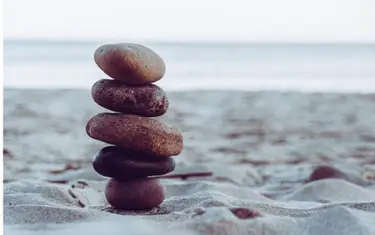
A Guided Practice: Noticing Moments of Balance in our Bodies
Key Steps
- First, notice what little thing(s) can offer me some relief or pleasure in my day-to-day life?
- Second, when I notice this relief or balance, pause and also notice: What’s a little different in my physical sensations, that lets me know I got some relief? What are one-two things that let me know something is a little different?
- And try to do this two-step practice at least once or twice each day.
Sensations. Some examples of physical sensations that we might notice include …
- Breathing (even or uneven, deep or shallow, softer or more labored, slower or faster)
- Visual perspective (closed-in and focused front, or open and more aware of horizon)
- Energy (even vs. jumpy, moving up vs. moving down)
- Mental state (clarity or fogginess, openness or pressure)
- Muscle tension (relaxed vs. tense, or engaged vs. collapsed)
- Temperature (warm vs. cool)
Anne: I like this small, simple practice because it can help us to reset our nervous systems: Each time we rebalance, we can reduce some accumulating stress level in the moment – so it does not build up quite as much by the end of the day. Then when we add in the second part, bringing attention to these small differences at a bodily level, we expand our capacity to more fully embody this felt sense of balance.
Over time, this simple practice strengthens our ability to take a critical break from stress. And it helps us to grow a deeper, internal sense of what feeling rebalanced is like from the inside out, in our bodies and minds.
This practice does not eliminate root causes of distress in our lives. And we absolutely support parallel, critical efforts to address root causes.
But in terms of building resilience in the face of these challenges, we’re talking about a small practice we can do right now: pause, rebalance, and expand our capacity to feel well in our bodies. This is part of resilience.
Friend: Yes. There are, for me, many ways that your body can reconnect with good things, good feelings. It is so unique for each person. We all deserve to experience this.
Continuing the Conversation
Integrativa online DVCN would love to know how these reflections resonate for you. Please feel free to share any of your experiences (info@integrativa-online.com). For our next conversation, we’ll discuss the challenges of providing community mental health support in our day-to-day work – and explore additional body-based practices relevant to caring for ourselves as we do this work.
How to cite: Eckman, A. K. (2026, April). Embodied well-being in our daily lives: A conversation on body awareness and mental health [Interview]. Integrativa online DVCN. https://integrativa-online.com/embodied-well-being-in-our-daily-lives/
Anne K. Eckman, PhD, LCSW-C, SEP is a mental health practitioner and facilitator who specializes in gender-based violence, community participatory processes, and body-integrated approaches to healing and resilience.